

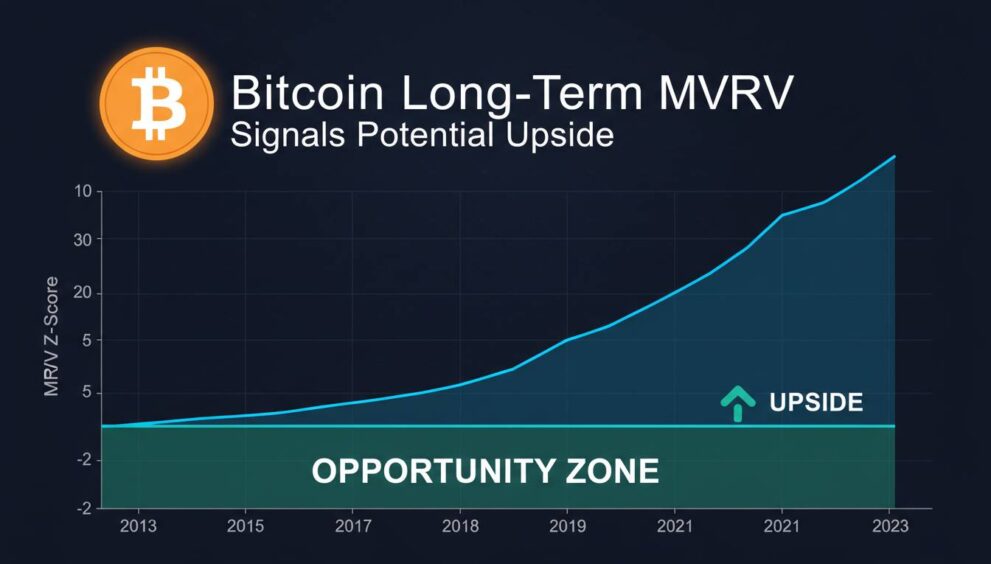
Bitcoin’s long-term holder valuation signal is still sitting in what on-chain analysts describe as an “opportunity” zone, even after sharp price swings in early 2026. As of March 19, 2026, Bitcoin trades at $70,831, while Glassnode’s long-term holder MVRV framework continues to show that older coins are profitable but not yet in the kind of euphoric territory that has historically marked late-cycle tops. That combination matters because it helps frame whether the market is still in an accumulation phase or moving into a more overheated stage.
Bitcoin Market Snapshot
$70,831
Down 4.23% on the day
$70,560 to $74,272
Source: market data feed
Opportunity zone
Per Glassnode framework for long-term holders
Sources: BTC market data as of March 19, 2026; Glassnode LTH-MVRV documentation and chart definitions
Glassnode’s long-term holder MVRV still points to a non-euphoric market
At the center of this story is the Long-Term Holder Market Value to Realized Value ratio, or LTH-MVRV. Glassnode defines the metric as the ratio between market value and realized value for Bitcoin held by long-term holders, a cohort made up of coins that have not moved for at least 155 days. In plain terms, it measures the average unrealized profit or loss of older, more conviction-driven holders.
That distinction matters. Short-term traders often react to momentum, liquidations, and macro headlines. Long-term holders usually behave differently. Their coins tend to move less frequently, and their profitability bands have historically helped analysts identify whether Bitcoin is trading in deep value territory, a neutral expansion phase, or an overheated zone where profit-taking risk rises.
Glassnode’s public documentation does not label every band with the same retail-friendly wording used in market commentary, but the underlying logic is clear: lower LTH-MVRV readings indicate that long-term holders are carrying smaller unrealized gains, while higher readings indicate richer profits and, by extension, greater incentive to distribute. When analysts say the metric is in an “opportunity” zone, they are usually referring to a range where long-term holders are profitable enough to avoid broad capitulation, but not so profitable that the market looks historically stretched.
That is the key nuance in March 2026. Bitcoin is not trading at the kind of depressed levels associated with full-scale panic, yet the long-term holder profitability profile also does not resemble the extreme readings seen near major cycle blow-off phases. For market participants trying to separate valuation from short-term noise, that makes LTH-MVRV one of the more useful on-chain gauges.
Why this metric gets attention
LTH-MVRV tracks unrealized profit for coins held at least 155 days. Lower readings have historically aligned with accumulation or early recovery phases, while elevated readings have coincided with stronger distribution incentives.
March 19, 2026 price action shows stress, but not a full valuation reset
Bitcoin changes hands at $70,831 on March 19, 2026, according to the latest market data, after trading as high as $74,272 and as low as $70,560 during the session. That daily decline of 4.23% is large enough to reset sentiment in the short run, especially after a rebound attempt earlier in March.
Even so, the move does not automatically invalidate the longer-term on-chain setup. A single-day drawdown can shake leverage out of the market without fundamentally changing the profitability profile of older holders. That is one reason analysts separate short-term holder metrics from long-term holder metrics. Short-term cohorts tend to experience sharper swings in unrealized profit and loss, while long-term cohorts move more slowly and often provide a cleaner read on broader cycle positioning.
Glassnode’s own educational material frames LTH-MVRV as a way to assess the behavior of long-term investors rather than day traders. In that framework, the question is not whether Bitcoin is volatile on a given day. The question is whether older holders are sitting on such large paper gains that they are likely to accelerate selling. The available evidence suggests that, despite volatility, the market has not yet reached the kind of long-term holder profit saturation that historically defines a late-stage euphoric environment.
That is why the “opportunity zone” language has traction. It implies a market that has already repriced enough to cool excesses, but not one that has fully broken down into structural weakness. For investors who rely on cycle metrics rather than intraday momentum, that distinction is significant.
Bitcoin Valuation Context on March 19, 2026
| Metric | Reading | Why It Matters |
|---|---|---|
| BTC Spot Price | $70,831 | Shows current market level after a sharp daily decline |
| Intraday High | $74,272 | Marks failed upside extension during the session |
| Intraday Low | $70,560 | Highlights downside pressure and volatility |
| LTH-MVRV Framework | Opportunity zone | Suggests long-term holder profits are not yet in extreme territory |
Source: BTC market data and Glassnode LTH-MVRV definitions | March 19, 2026
How the 155-day holder split changes the reading
Not all MVRV readings tell the same story. The standard MVRV ratio looks at the entire market, comparing Bitcoin’s market capitalization with its realized capitalization. LTH-MVRV narrows the lens to coins that have aged at least 155 days, which Glassnode uses as the threshold for long-term holders.
This matters because older coins often belong to investors with lower time preference and stronger conviction. They are less likely to react to every macro headline or liquidation cascade. When their unrealized profits become very large, distribution pressure can build gradually and then show up in on-chain spending. When their profits compress, the market can move back into a zone where the risk-reward profile improves for patient buyers.
That is why long-term holder metrics are often treated as cycle tools rather than trading tools. They do not pinpoint the next hourly move. Instead, they help answer a broader question: is Bitcoin expensive relative to the cost basis of the investors who historically drive major supply shifts?
In early 2026, several public market commentaries citing Glassnode and CryptoQuant data have pointed to a market that is no longer overheated by the standards of prior peaks. Some reports also note that long-term holders have slowed aggressive selling compared with heavier distribution periods seen in 2025. While those secondary reports should be treated carefully, they broadly align with the interpretation that long-term holder profitability has cooled from hotter levels and moved closer to a zone associated with accumulation rather than mania.
The practical takeaway is straightforward. If long-term holders are still in profit but not in extreme profit, Bitcoin can remain volatile without necessarily being historically overvalued. That does not guarantee upside. It does mean the on-chain backdrop looks different from the conditions that usually precede major exhaustion tops.
How the LTH-MVRV signal is interpreted
Glassnode classifies coins unmoved for at least 155 days as belonging to long-term holders.
When LTH-MVRV falls, older holders carry smaller paper gains, reducing the sense of market overheating.
When LTH-MVRV rises sharply, long-term holders have more incentive to distribute into strength.
Why “opportunity zone” does not mean “bottom is confirmed”
The phrase sounds bullish, but it should not be overstated. An opportunity zone is not the same thing as a guaranteed bottom. It is a valuation signal, not a certainty about timing. Bitcoin can stay undervalued or moderately valued for extended periods, especially when macro conditions are unstable or derivatives positioning is still being cleared.
That distinction is important in March 2026 because the broader market backdrop remains sensitive to liquidity, rates, and risk appetite. Even if long-term holder profitability looks constructive, short-term price action can still be driven by leverage, ETF flows, macro headlines, and positioning in futures markets. A valuation metric can improve while price remains choppy.
There is also a difference between “not overheated” and “deeply distressed.” Some of the strongest historical buying windows in Bitcoin came when broader MVRV-based indicators fell much further and sentiment was far weaker. By contrast, the present setup appears to be one of moderated profitability rather than outright capitulation. That can still support upside over time, but it is a different kind of signal.
In other words, the long-term holder cohort is not flashing the same warning signs that usually accompany late-cycle excess. That is constructive. But the market still needs demand, liquidity, and sustained risk appetite to convert that valuation backdrop into a durable trend higher.
What the signal does not say
LTH-MVRV does not predict exact tops or bottoms. It measures unrealized profitability for older holders and is best used with price, liquidity, and positioning data rather than in isolation.
Bitcoin’s long-term holder behavior matters because supply is sticky
One reason LTH-MVRV carries weight is that long-term holders control a meaningful share of Bitcoin’s supply at any given time. When those holders sit on modest profits, they often show less urgency to sell than when they are sitting on outsized gains after a strong rally. That can tighten liquid supply and make the market more responsive to renewed demand.
Public reporting in 2025 and early 2026 has repeatedly highlighted periods in which long-term holders either slowed distribution or resumed accumulation after corrections. While the exact pace varies by dataset and methodology, the broader pattern is consistent with how Bitcoin has behaved in prior cycles: older coins tend to become more active near richer profit zones and quieter when profitability compresses.
That dynamic helps explain why an “opportunity zone” reading can matter even when price action looks messy. If the most patient cohort is not under strong pressure to sell, the market’s available supply can remain relatively constrained. In that environment, upside can reappear quickly if demand improves.
By comparison, when long-term holder profitability reaches extreme levels, the opposite risk emerges. Older holders have a larger incentive to realize gains, and that supply can cap rallies or intensify reversals. The absence of that condition today is part of the bullish interpretation behind the current signal.
Still, supply-side support is only one side of the equation. Demand has to meet it. That is why traders and analysts continue to watch spot flows, derivatives leverage, and macro catalysts alongside on-chain valuation metrics.
LTH-MVRV Interpretation Framework
| Zone | Holder Condition | Typical Market Reading |
|---|---|---|
| Low | Long-term holders have compressed profits or losses | Value or accumulation conditions may improve |
| Mid-range | Profits are positive but not extreme | Expansion phase without clear euphoria |
| High | Long-term holders have large unrealized gains | Distribution risk and overheating concerns rise |
Source: Glassnode LTH-MVRV methodology and historical market interpretation
What traders and investors should watch after the March 19 reset
After a daily move that pushed Bitcoin down to $70,831, the next question is whether the market stabilizes with long-term holder support intact or whether weakness spills into broader sentiment. The answer will likely come from a mix of on-chain and market-structure signals rather than from LTH-MVRV alone.
First, traders will watch whether Bitcoin can hold above the session low near $70,560. A stable base after a sharp drop would suggest that leverage is being flushed without a deeper deterioration in spot demand. Second, analysts will monitor whether long-term holder profitability remains in the same broad valuation band. If the metric stays in an opportunity-style zone while price consolidates, the market may continue to look constructive on a medium-term basis.
Third, derivatives positioning matters. Public reports in recent weeks have cited Bitcoin futures open interest around the high-$40 billion range on Coinglass, a sign that leverage remains relevant even after prior resets. If open interest rebuilds too quickly without corresponding spot demand, volatility can return. If leverage stays contained while spot demand improves, the setup becomes healthier.
Finally, macro conditions remain part of the equation. Bitcoin does not trade in isolation. Rate expectations, dollar strength, equity volatility, and ETF-related flows can all influence whether a favorable on-chain valuation signal translates into price appreciation.
The broad message from the data is not that upside is guaranteed. It is that Bitcoin’s long-term holder profitability profile still looks more like a market with room to run than one already deep in speculative excess. For a cycle-driven asset, that is a meaningful distinction.
Conclusion
Bitcoin’s long-term holder MVRV signal remains one of the cleaner ways to judge where the market sits in its broader cycle. In March 2026, that signal still points to an “opportunity” style zone rather than a euphoric one. Bitcoin’s spot price at $70,831 shows that volatility is still high, but the profitability of older holders does not yet resemble the kind of extreme condition that has historically preceded major tops.
That does not confirm a bottom, and it does not remove macro or leverage risk. What it does suggest is that Bitcoin’s valuation, when measured against the cost basis of long-term holders, is still relatively restrained. If demand improves and supply from older holders stays muted, that backdrop can support further upside. If macro pressure intensifies, the signal may remain constructive while price stays volatile. Either way, the long-term holder data argues for a market that is cooler than the headline swings might imply.
Frequently Asked Questions
What is Bitcoin’s long-term holder MVRV?
Bitcoin’s long-term holder MVRV, or LTH-MVRV, is an on-chain ratio that compares market value with realized value for coins held at least 155 days. Glassnode uses it to measure the unrealized profit or loss of long-term holders and to assess whether that cohort is in a low-profit, neutral, or overheated state.
Why does an “opportunity zone” matter for Bitcoin?
An opportunity zone generally means long-term holders are profitable, but not to an extreme degree. That matters because historically rich unrealized profits can increase selling pressure, while more moderate profitability often aligns with accumulation or earlier-stage recovery conditions rather than late-cycle euphoria.
What is Bitcoin’s price on March 19, 2026?
Bitcoin trades at $70,831 on March 19, 2026, with an intraday high of $74,272 and an intraday low of $70,560. That places the asset down 4.23% on the day based on the latest available market data at the time of writing.
Does the opportunity zone mean Bitcoin has bottomed?
No. The signal reflects valuation and holder profitability, not a guaranteed timing call. Bitcoin can remain in a constructive valuation range while price continues to fluctuate because macro conditions, derivatives positioning, and spot demand still influence short-term direction.
Why do analysts focus on the 155-day threshold?
Glassnode uses 155 days as the cutoff for long-term holders because coins that remain unmoved for that period have historically shown different spending behavior from newer coins. The split helps separate conviction-driven supply from more reactive short-term trading activity.
What should investors watch next?
The next signals to watch are whether Bitcoin holds above recent lows, whether long-term holder profitability stays in the same broad band, and whether derivatives leverage cools or rebuilds. Those factors help determine whether a favorable on-chain setup can translate into stronger price performance.
Disclaimer: This article is for informational purposes only and is not investment advice. Cryptocurrency markets are volatile, and past on-chain patterns do not guarantee future performance. Readers should verify data independently and assess their own risk tolerance before making financial decisions.