

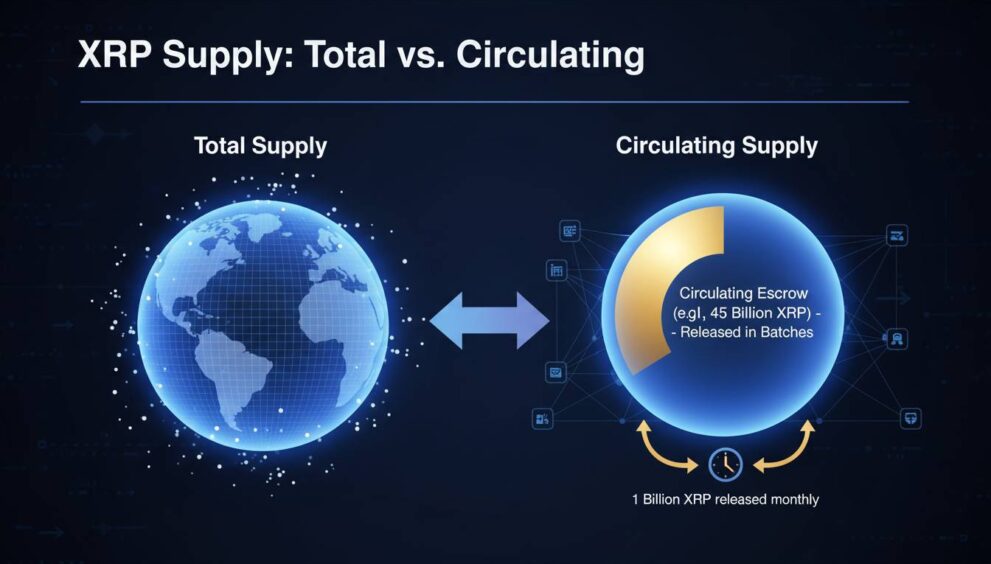
XRP’s supply looks unusually large at first glance: the token has a fixed maximum supply of 100 billion units, with roughly 61.2 billion in circulation and the rest largely locked in on-ledger escrow, according to CoinMarketCap, CoinGecko, Ripple, and XRPL documentation reviewed in March 2026. That headline number matters less than many investors assume because price is set by market capitalization, circulating float, release controls, and utility on the XRP Ledger—not by the raw token count alone.
📊
The key point:
XRP’s unit count is high, but its supply is capped, most non-circulating tokens are governed by escrow, and every transaction destroys a small amount of XRP as a fee, according to XRPL and Ripple materials accessed in March 2026.
XRP Supply Snapshot
| Metric | Value | Source |
|---|---|---|
| Maximum supply | 100,000,000,000 XRP | XRPL / CoinMarketCap |
| Circulating supply | About 61.2 billion XRP | CoinMarketCap / CoinGecko |
| Ripple-held XRP | 4.56 billion XRP | Ripple, March 31, 2025 |
| XRP in on-ledger escrow | 37.13 billion XRP | Ripple, March 31, 2025 |
Source: XRPL, Ripple, CoinMarketCap, CoinGecko | accessed March 21, 2026
100 Billion XRP Does Not Mean XRP Must Trade Cheap
A large token count does not automatically make an asset over-supplied. In crypto markets, valuation is determined by market capitalization, which equals price multiplied by circulating supply. A token with 100 billion units can still support a high valuation if demand, liquidity, and usage are strong enough; conversely, a token with only 21 million units can still trade lower if demand is weaker. That is why comparing XRP’s unit count with Bitcoin’s 21 million cap is usually misleading.
CoinMarketCap lists XRP with a circulating supply of 61,227,832,454 coins, while CoinGecko describes roughly 61 billion tokens as tradable on the market. Those figures are large in absolute terms, but they also explain why XRP can be used in small denominations for payments, exchange settlement, and ledger activity without requiring many decimal places. In practical market terms, a higher unit count can improve usability rather than weaken the asset by itself.
The more relevant question is whether supply is expanding unpredictably. On that point, XRP differs from inflationary tokens because its maximum supply is fixed at 100 billion. XRPL documentation states that XRP was created at inception, not mined over time, and no new XRP can be minted under the protocol’s design. That means the debate is about distribution and release pace, not about unlimited issuance.
37.13 Billion in Escrow Changes the Real Float
The strongest factual argument against the “billions are a problem” thesis is the escrow structure. Ripple’s Q1 2025 XRP Markets Report says that as of March 31, 2025, Ripple held 4.562 billion XRP directly and 37.13 billion XRP was subject to on-ledger escrow. Ripple also states it does not have access to escrowed XRP until scheduled monthly releases occur, and that unused released XRP is generally returned to escrow.
That matters because market pressure depends on liquid float, not on the theoretical maximum supply. If tens of billions of tokens are locked under transparent ledger rules, they are not equivalent to immediately tradable inventory. XRPL’s own overview explains that Ripple locked 55 billion XRP into escrow to provide predictability to supply, a mechanism designed to reduce uncertainty around distribution.
XRP Supply Timeline
At network launch: XRP’s 100 billion maximum supply is created at inception, with no mining-based inflation afterward.
Escrow era: Ripple locks 55 billion XRP into on-ledger escrow to make release schedules more predictable.
December 31, 2024: Ripple reports 4.485 billion XRP held directly and 38.03 billion XRP in escrow.
March 31, 2025: Ripple reports 4.562 billion XRP held directly and 37.13 billion XRP in escrow.
Historical context also helps. Ripple’s reported escrow balance fell from 38.03 billion XRP on December 31, 2024 to 37.13 billion XRP on March 31, 2025, while direct holdings rose modestly from 4.485 billion to 4.562 billion. That is a controlled shift, not evidence of sudden supply flooding. The data show a managed release framework with public reporting, which is materially different from opaque treasury unlocks seen elsewhere in crypto.
How Fee Burning Creates a Mild Deflationary Offset
XRP is not only capped; it is also slightly deflationary in protocol terms because transaction fees are destroyed rather than paid to validators. XRPL’s transaction-cost documentation states that the fee is burned, and the fee-voting system allows validators to adjust the minimum transaction cost and reserve requirements over time.
The amount burned per transaction is small. XRPL documentation cites a typical fee around 12 drops, or 0.000012 XRP, in one reserve-related example, and explains that the base fee is measured in drops of XRP. This does not remove supply fast enough to become the main valuation driver, but it does mean XRP’s total supply trends downward very gradually rather than upward.
That mechanism is important in comparative terms. Bitcoin’s circulating supply rises until its issuance schedule ends. Ethereum’s supply changes according to issuance and burn dynamics. XRP, by contrast, starts with a fixed cap and then slowly declines as fees are destroyed. So the “billions” headline misses a structural point: XRP’s supply is large, but it is neither open-ended nor inflationary in the conventional sense.
XRP vs Common Supply Misconceptions
| Question | Factual answer |
|---|---|
| Can more XRP be minted? | No. XRPL documentation says the maximum supply is fixed. |
| Are all 100 billion XRP tradable now? | No. A large share remains in escrow or outside active circulation. |
| Does XRP supply increase with mining? | No. XRP is not mined like Bitcoin. |
| Are transaction fees recycled to validators? | No. XRPL says fees are destroyed. |
Source: XRPL, Ripple | accessed March 21, 2026
61 Billion Circulating XRP Matters More Than the Headline Number
For valuation, the circulating supply is the more useful metric than the maximum supply. CoinMarketCap places XRP’s circulating supply at 61.23 billion, while CoinGecko rounds it to 61 billion. Those services also distinguish between market capitalization and fully diluted valuation, reinforcing a standard crypto-market practice: traders price the liquid or near-liquid float first, then assess future unlocks separately.
That distinction is not unique to XRP. Many digital assets have a gap between circulating supply and maximum supply because of vesting, treasury holdings, staking locks, or protocol schedules. CoinGecko’s 2025 reporting notes that fully diluted valuation can overstate value when supply will not enter the market anytime soon. Applied to XRP, that means the existence of a 100 billion cap does not by itself prove near-term dilution risk.
There is also a usability angle. XRP was designed for payments and settlement, where a larger unit count can make quoting and transferring value simpler. Instead of requiring users to think in tiny fractions for routine transfers, a larger supply supports whole-unit or low-decimal pricing. That does not create value on its own, but it explains why a high token count is not inherently a flaw in a payments-oriented asset.
Institutional XRPL Activity Adds Utility Beyond Supply Math
Supply concerns also need to be weighed against network use cases. Ripple announced in January 2025 that Ondo Finance would bring tokenized U.S. Treasuries to the XRP Ledger, and in another 2025 statement said Guggenheim Treasury Services used the XRPL for digital commercial paper issuance through the Zeconomy platform. Those announcements do not directly change XRP supply, but they matter because utility and institutional adoption affect demand for ledger access and settlement.
In other words, the market does not evaluate supply in isolation. If a network gains more payment, tokenization, or treasury use, participants may tolerate a larger unit count because the asset serves a broader role. Ripple’s Q1 2025 report also said XRP-based investment products recorded $37.7 million in inflows, bringing year-to-date inflows to $214 million at that time. That figure is not a direct measure of spot demand, but it shows that institutional interest can coexist with a large nominal supply.
ℹ️
Why this matters for investors:
The relevant risk is not “XRP has billions of coins,” but whether escrow releases, liquidity, and demand growth stay balanced. Public escrow reporting makes that easier to monitor than in many token projects.
Frequently Asked Questions
Frequently Asked Questions
Does XRP’s 100 billion supply make it overpriced or underpriced?
No. Supply count alone does not determine valuation. Market capitalization uses price multiplied by circulating supply, and CoinMarketCap and CoinGecko both separate circulating supply from maximum supply for that reason. XRP’s roughly 61 billion circulating supply is more relevant for market pricing than the 100 billion cap.
Can Ripple suddenly release all escrowed XRP into the market?
Ripple says escrowed XRP is locked on-ledger and released on a monthly schedule, with unused released amounts generally returned to escrow. In its Q1 2025 report, Ripple listed 37.13 billion XRP in escrow as of March 31, 2025, which indicates a structured release process rather than immediate full access.
Is XRP inflationary like mined cryptocurrencies?
No in the conventional sense. XRPL documentation says XRP’s full maximum supply was created at inception, and no new XRP is minted through mining. In addition, XRPL transaction fees are destroyed, which creates a small deflationary effect over time.
Why do some investors still worry about XRP supply?
The main concern is distribution, not unlimited issuance. Investors watch Ripple’s holdings, escrow balances, and release patterns because those factors affect liquid float and potential sell pressure. Ripple publishes holdings data in its markets reports, which gives the market a public benchmark for monitoring changes.
What is the simplest way to judge whether XRP supply is a problem?
Focus on four metrics: circulating supply, escrow balance, Ripple-held XRP, and actual market demand. As of the sources reviewed in March 2026, XRP has a fixed 100 billion cap, about 61.2 billion circulating, and more than 37 billion previously reported in escrow, which means the raw “billions” figure alone is incomplete.
Conclusion
XRP’s supply in the billions is not automatically a problem because the token’s economics are defined by a fixed cap, transparent escrow controls, a circulating supply that is smaller than the maximum, and a fee-burning mechanism that slowly reduces total supply. The better question is not how many units exist, but how many are liquid, how predictably they are released, and whether network utility supports demand. On the publicly available data reviewed here, XRP’s large nominal supply is a design feature that needs context—not a standalone red flag.
Disclaimer: This article is for informational purposes only and is not financial or investment advice. Cryptocurrency markets are volatile, losses can be total, and readers should verify data independently and consult a qualified financial adviser before making investment decisions.