

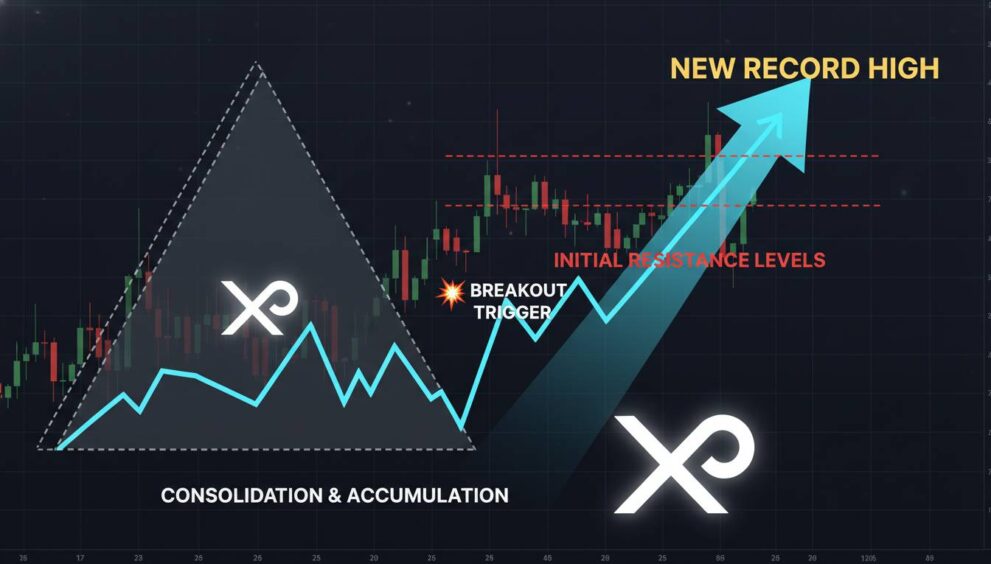
XRP Breakout Forecast: Analyst Reveals Path to Record High
XRP changes hands near $1.37 on March 19, 2026, with 24-hour volume ranging from about $1.92 billion on CoinMarketCap to roughly $4.39 billion on TradingView market data, showing active but uneven liquidity across venues. The token remains far below its reported all-time high near $3.67 on TradingView and below the 2025 peak cited by several market trackers. That gap is the core of the breakout debate: whether XRP can reclaim higher resistance zones and rebuild momentum strong enough to challenge record territory.
The bullish case is straightforward but demanding. XRP does not need a narrative alone; it needs a sequence of measurable changes. Price must first hold above nearby support, then clear short-term resistance, then attract enough spot and derivatives participation to sustain a move rather than produce another failed rally. Publicly available market data shows XRP is trading in a much lower range than it did in March 2025, when CoinMarketCap’s historical snapshot placed it at $2.5458 with a market capitalization of about $147.94 billion and 24-hour volume near $9.59 billion. That comparison matters because it shows how much participation has faded since the stronger phase of the cycle.
XRP Market Snapshot
$1.37
CoinGecko and CoinMarketCap both show XRP near this level
$1.92B to $4.39B
Range reflects source and venue differences
$84.19B to $86.00B
Top-tier crypto asset by market value
$3.66596
Still far above the current market
Sources: CoinGecko, CoinMarketCap, TradingView market page; accessed March 19, 2026.
March 19, 2026 Price Gap Shows the Size of the Recovery Task
A move back to record highs is not a small extension from current levels. Using TradingView’s reported all-time high of $3.66596 and a spot price near $1.37, XRP would need to gain roughly 168% to revisit that peak. Even if one uses older reference points around the 2018 cycle high near $3.40, the required advance is still well above 140%. That is why breakout language needs context. XRP is not sitting at the edge of a record; it is sitting in a rebuilding phase after a large retracement from 2025 highs.
The historical comparison is stark. CoinMarketCap’s March 19, 2025 snapshot shows XRP at $2.5458 with 24-hour volume of $9.59 billion and circulating supply of 58.11 billion XRP. By March 2026, CoinMarketCap lists XRP near $1.37, market cap near $84.19 billion, and 24-hour volume near $1.92 billion. TradingView’s market page places market cap slightly higher at about $86.00 billion and volume at $4.39 billion, but both sources point in the same direction: XRP is trading far below the liquidity and valuation conditions seen a year earlier.
That does not invalidate a breakout thesis. It simply means the path back to a record high likely requires several stages rather than one vertical move. First comes stabilization. Then comes a reclaim of intermediate resistance. Only after that does the market begin to test whether broader participation is returning. Without that sequence, any analyst map to an all-time high is only a scenario, not a confirmed trend.
XRP Then vs. Now
| Metric | March 19, 2025 | March 19, 2026 |
|---|---|---|
| Price | $2.5458 | About $1.37 |
| 24h Volume | $9.59B | $1.92B to $4.39B |
| Market Cap | $147.94B | $84.19B to $86.00B |
| Circulating Supply | 58.11B XRP | 61.09B XRP |
Sources: CoinMarketCap historical snapshot for March 19, 2025; CoinMarketCap and TradingView data accessed March 19, 2026.
What Would Need to Break First to Put $3-Plus Back in Play?
The first requirement is not the all-time high itself. It is the recovery of nearer resistance bands. TradingView’s XRP market page says the token is consolidating around $1.41, with support at $1.33. It adds that a drop below that zone could expose $1.20 to $1.15, while a rise above $1.48 may open the way toward $1.60. Those are not record levels, but they are the thresholds that matter if the market wants to prove that a higher-high structure can form again.
In practical terms, an analyst mapping a path to a record high would likely need to show at least four checkpoints. The first is defense of the $1.33 area. The second is a clean move through the $1.48 region. The third is acceptance above $1.60, which would begin to shift the market away from a low-range recovery and toward a broader trend reversal. The fourth is a return to the $2 zone, where XRP previously spent time during stronger periods of the 2024-2025 cycle.
This is where market structure becomes more important than headline excitement. A breakout that reaches $1.48 and then fails is not the same as a breakout that reaches $1.48, consolidates, and builds volume. The latter suggests spot demand is absorbing supply. The former often reflects short covering or temporary leverage. For XRP, the distinction matters because the token has already experienced a deep drawdown from its 2025 highs. Markets coming off that kind of decline usually need repeated confirmation before a durable uptrend is accepted.
$1.48 and $1.60 are the nearer test zones
TradingView’s XRP market page identifies support near $1.33 and says a rise above $1.48 may target $1.60. For any path back to record highs, those lower thresholds have to be cleared first.
Derivatives Data Adds a Second Test for Any XRP Breakout
Spot price alone rarely tells the full story in crypto. Derivatives positioning often reveals whether traders are adding conviction or simply reacting to short-term moves. Public reporting tied to Coinglass data showed XRP funding rates jumping sharply on March 10, 2026, while price moved above $1.43 and open interest increased. One report cited funding reaching $0.00619 and open interest rising 2.43%. Even allowing for inconsistencies in third-party summaries, the broader message is clear: when XRP rallies, leverage returns quickly.
That can help a breakout, but it can also weaken it. If open interest rises too quickly without corresponding spot demand, the market becomes more vulnerable to liquidation-driven reversals. Earlier 2026 reporting also described weaker derivatives conditions, including negative funding and lower open interest during February. That means XRP has already shown both sides of the setup this year: periods of leverage stress and periods of renewed speculative interest.
For a credible path back to an all-time high, derivatives data would ideally show three things at once. Open interest should rise in a controlled way rather than spike vertically. Funding should stay positive or near neutral without becoming excessively crowded. Volume should expand across spot venues, not just perpetual futures. If those conditions align, leverage supports the move. If they do not, leverage can become the reason the move fails.
This is one reason analysts often overstate the significance of a single price breakout. A candle through resistance is visible. The quality of participation behind that candle is more important. XRP’s next sustained advance, if it comes, likely needs both spot accumulation and disciplined derivatives expansion.
Ripple’s 2025-2026 Product Push Gives XRP a Fundamental Backdrop
Price action does not happen in a vacuum, and XRP’s market narrative in 2026 is tied closely to Ripple’s broader product expansion. Ripple said in June 2025 that RLUSD was approved by the Dubai Financial Services Authority as a recognized crypto token for use within the Dubai International Financial Centre. Ripple also said in late 2025 that RLUSD had surpassed $700 million in market capitalization, and in a November 2025 announcement with Mastercard, WebBank, and Gemini it said the stablecoin had grown to more than $1 billion in circulation. In January 2026, Ripple said Binance listed RLUSD for spot trading on Ethereum, with XRPL support coming later.
Those developments do not automatically translate into XRP price gains, but they do matter for the ecosystem story. Ripple’s public statements repeatedly position RLUSD and XRP as complementary parts of its payments and liquidity stack. The company also announced plans on March 11, 2026 to secure an Australian Financial Services License, saying RLUSD and XRP underpin its solutions. That gives market participants a concrete stream of business and infrastructure updates to monitor rather than relying only on chart-based narratives.
The key distinction is between ecosystem growth and token-price transmission. Ripple can expand payments, custody, and stablecoin distribution without producing an immediate one-for-one move in XRP. Still, stronger utility, more integrations, and broader institutional visibility can improve sentiment and liquidity conditions over time. For a market trying to justify a return to record highs, that kind of fundamental backdrop is more durable than social-media speculation.
Ripple and XRPL-Linked Milestones Relevant to XRP Sentiment
Ripple says the Dubai Financial Services Authority recognized RLUSD for use within the Dubai International Financial Centre.
Ripple says the stablecoin surpassed $700 million in market capitalization as adoption expanded across DeFi and payments.
Ripple says RLUSD exceeded $1 billion in circulation as it explored stablecoin settlement for fiat card transactions.
Ripple says the listing broadens access and visibility for the stablecoin.
Ripple says it plans to secure an Australian Financial Services License as part of its APAC expansion.
168% to the Record: The Scenario Tree Behind an XRP Return
If XRP is to revisit its reported all-time high near $3.67, the move likely unfolds in stages rather than in one uninterrupted run. Scenario one is the constructive path. XRP holds above the $1.33 support region, breaks through $1.48, establishes trade above $1.60, and then rebuilds toward the $2 area with rising spot volume. In that case, the market begins to close the gap between present pricing and the stronger conditions seen in 2025.
Scenario two is a false-start path. XRP breaks resistance briefly, derivatives positioning expands too fast, funding becomes crowded, and the token falls back into the prior range. That kind of move can still produce sharp short-term gains, but it does not create the base needed for a multi-month recovery toward record levels. Crypto markets often confuse these two patterns because both begin with a breakout candle.
Scenario three is the bearish reset. XRP loses the $1.33 area identified by TradingView and revisits the $1.20 to $1.15 zone. In that case, any path to an all-time high becomes longer and more conditional because the market would first need to repair lower support before even discussing higher resistance. That is why support matters as much as upside targets.
The math also keeps expectations grounded. From $1.37 to $2.00 is a gain of about 46%. From $2.00 to $3.00 is another 50%. From $3.00 to $3.66596 is roughly 22%. Each leg requires fresh capital, stronger sentiment, and enough liquidity to absorb profit-taking. Analysts can map that route, but the market still has to supply the evidence one stage at a time.
Illustrative XRP Recovery Ladder
| Level | Approx. Gain from $1.37 | Why It Matters |
|---|---|---|
| $1.48 | 8% | Near-term breakout threshold cited on TradingView |
| $1.60 | 17% | Would confirm follow-through above first resistance |
| $2.00 | 46% | Psychological and structural recovery zone |
| $3.00 | 119% | Would place XRP back near upper-cycle territory |
| $3.66596 | 168% | TradingView reported all-time high |
Source: Calculator based on spot price near $1.37 and TradingView all-time high data, March 19, 2026.
How XRP Compares With Its Own 2025 Strength Matters More Than Hype
One of the clearest ways to judge the breakout thesis is to compare XRP with its own prior cycle behavior rather than with exaggerated forecasts. In March 2025, XRP traded above $2.54 with nearly $9.6 billion in daily volume on CoinMarketCap’s snapshot. In March 2026, it sits near $1.37 with materially lower turnover. That means the market has not yet rebuilt the same intensity of participation that existed during stronger phases.
By comparison, TradingView’s market page shows XRP down 23.47% year to date and nearly 50% over six months. Those figures reinforce the same point: the asset is still in recovery mode, not in confirmed price discovery. A return to record highs is possible in crypto because volatility is high, but the data available on March 19, 2026 does not show XRP already on the doorstep of that outcome.
What it does show is a market with enough liquidity, enough ecosystem relevance, and enough trader attention to make the question legitimate. XRP remains one of the largest digital assets by market capitalization. Ripple continues to expand stablecoin and payments infrastructure. Short-term resistance levels are clearly defined. That combination gives analysts room to build a path-to-ATH framework. It does not yet give them confirmation.
Conclusion
XRP’s breakout case rests on measurable milestones, not slogans. On March 19, 2026, the token trades near $1.37, far below both its 2025 highs and TradingView’s reported all-time high near $3.67. For a return to record territory, XRP likely needs to defend support near $1.33, reclaim $1.48 and $1.60, rebuild volume toward prior-cycle levels, and show healthier derivatives participation rather than a short-lived leverage spike.
Ripple’s expanding RLUSD and payments strategy gives the asset a stronger fundamental backdrop than a pure chart story would suggest. Even so, the market data says the recovery is incomplete. The path exists, but it is staged, conditional, and still unproven.
Frequently Asked Questions
What is XRP’s price right now?
On March 19, 2026, CoinGecko and CoinMarketCap both place XRP near $1.37. TradingView’s XRP market page also shows the asset trading in the same general range, though exact prices can vary slightly by exchange and timestamp.
How far is XRP from its all-time high?
Using TradingView’s reported all-time high of $3.66596 and a spot price near $1.37 on March 19, 2026, XRP sits about 63% below that peak and would need to rise roughly 168% to revisit it.
What levels matter most for an XRP breakout?
TradingView’s market page identifies support near $1.33 and says a rise above $1.48 may target $1.60. Those are the nearer thresholds to watch on March 19, 2026 before any discussion of a move back toward $2 or higher.
Why do derivatives matter for XRP’s next move?
Derivatives data helps show whether a rally is supported by sustainable participation or by crowded leverage. March 2026 reporting tied to Coinglass data showed funding and open interest rising during XRP rebounds, which can support momentum but also increase reversal risk.
Does Ripple’s RLUSD expansion directly raise XRP’s price?
Not directly. Ripple’s announcements from 2025 and 2026 show RLUSD expanding through regulatory approvals, exchange listings, and payments integrations. Those developments can strengthen ecosystem sentiment and utility, but they do not guarantee a one-for-one increase in XRP’s market price.
Disclaimer: This article is for informational purposes only and is not investment advice. Digital assets are volatile, and past market performance does not guarantee future results. Verify market data independently before making financial decisions.